
Who We Are
From Frozen Line to Field Recovery
Why I Got Into Septic Field Remediation
In 2017, I purchased an early 1980s acreage property. I grew up in Edmonton, fully connected to municipal services, and I had very little exposure to septic systems. Like many people who move from the city to an acreage, I relied on the home inspection. The report stated that the tanks were aging but the system was functioning.
That was enough for me to move forward with the purchase, but it left a quiet concern in the back of my mind.
For several years, I treated the septic system the way many acreage owners do. I avoided it. Unfortunately, septic systems have a way of demanding attention on their own terms.
The First Freeze
My first real lesson came during a cold winter with minimal snow cover. Around 10 pm on a Sunday night, I learned that my system had frozen and was backing up in my basement. I have a background in water management, so I worked late into the night to rectify using what I had available. I solved the immediate backup, but I knew I had not solved the underlying issue.
The following winter, it froze again.
That was the moment I stopped reacting and started learning.
The Cost Reality
As I began studying septic systems more closely, I realized something most homeowners eventually discover. The cost of replacement is significant. Forty thousand dollars is common. Fifty thousand is not unusual. In some cases, especially with advanced treatment requirements or difficult site conditions, costs can exceed one hundred thousand dollars. Even then, a new system simply begins the same biological process again, destined for failure.
I am naturally wired to solve problems. I researched. I spoke with contractors. I studied system design, hydraulics, and winter performance. I resolved the freezing issue by correcting drainage in my pump discharge line, which had been holding water in the frost zone. That explained my recurring freeze ups.
But while working around my system, I also began to see the cumulative effects of over forty years of operation on the tanks and field. Around that same time, my neighbour experienced a septic field failure. Effluent began surfacing in his yard, and his home was newer than mine. That was sobering. It made it clear that age alone does not dictate failure.
I knew I was operating on borrowed time.
Several months later, that same neighbour approached me in my driveway. He was excited. He had installed an Aerobic Bacteria Generator system and explained how it was intended to restore biological balance and improve field performance. Around the same period, a close friend who lives nearby was dealing with a failing system of his own.
Discovering the Biological Cause
As we began discussing this technology, we learned something critical. The most common cause of septic field failure is not structural collapse. It is biomat. Biomat is a dense biological layer that forms at the soil interface where effluent enters the field. Over time, it restricts infiltration, reduces hydraulic conductivity, and eventually leads to surfacing or backup.
If biomat is a biological problem, it could be addressed biologically.
This aligned perfectly with my friend’s background. His company Delta Remediation specializes in bioremediation, using microbiology to degrade hydrocarbons and other contaminants in soil and groundwater. He employs biologists and technical professionals whose work revolves around enhancing natural biological processes. He has long believed there is a better way to manage waste than excavation and disposal.
That mindset resonated with me deeply.
We began exploring the science behind aerobic remediation systems. In that process, we discovered the original inventor of this technology, a septic industry veteran in California with over fifty years of experience and more than twenty five years refining aerobic remediation devices. The unit my neighbour had installed was derived from an early version of his technology.
After extensive discussions, we decided to license his proven technology for manufacturing and distribution in Canada.
However, before bringing anything to market, we needed to see it work ourselves.
Testing the Technology Ourselves
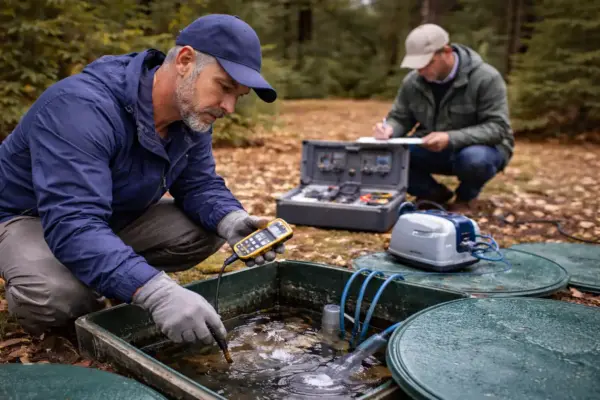
We installed systems on our own properties. We instrumented the tanks with remote temperature monitoring. We tracked liquid temperatures, ambient air conditions, biological response, and winter performance. One of our primary concerns was whether introducing cold air during Canadian winters would risk freezing or destabilizing the biological environment.
At my colleague’s property, we installed licensed systems in both his primary solids chamber and his failing seepage pit. At my own home, at the inventor’s recommendation, I installed our prototype design using the licensed bacterial blend. He encouraged me to test our own build so I could see performance differences firsthand.
From Prevention to Remediation
During installation at my property, I identified the freezing issue I mentioned earlier. While correcting that problem and triggering a pump cycle, I heard a gurgling sound near my children’s playset. Effluent surfaced. My field had failed after 42 years.
In that moment, what had been a preventative trial became a remediation case study.
What the Data Revealed
Over the following weeks and months, we monitored both systems closely. Liquid temperatures in my tank dropped from approximately seventeen degrees Celsius down to just under eight degrees during extended minus thirty weather. This confirmed that introducing air did not create freezing risk within the tank.
The biological performance revealed something even more important.
In my colleague’s tank with the licensed system, the crust layer broke down within roughly six to eight weeks. Solids began mixing and digesting rapidly. In my tank, using our prototype housing and diffusion configuration for comparison, crust breakdown was slower and incomplete.
That difference became a defining lesson. The inventor walked me through why performance varied. Growth media design matters. Air diffusion patterns matter. Housing geometry matters. Aeration alone is not enough and biology must be supported properly.
After allowing sufficient time for comparison, I replaced my prototype with the licensed unit. The improvement was immediate. The crust layer disappeared. Solids liquefied. The tank clarified significantly, even through the remainder of winter.
By spring, the surfacing effluent in my yard was gone. (It has not returned nearly two years later.)
At my colleague’s property, his seepage pit, which previously required pumping every few months, has now gone over a year without pump out. Seepage pits recover more gradually due to deeper and denser biomat formation, but measurable improvement has continued steadily.
Moving From Trial to Company
With firsthand experience, monitored data, and clear biological response, we felt confident moving forward.
In our first season, we installed approximately fourteen systems across various system types, including gravity fields, mounds, and legacy configurations. Several heavily failed mounds showed significant recovery. Areas that had effectively become wetlands dried up. Systems that had been surfacing stopped surfacing. Bell and siphon systems stabilized and stopped overflowing.
Not every system is recoverable and we advised the customer to pursue other paths to correct their issues. Some are structurally compromised. Some have hydraulic limitations that biology cannot correct. We are transparent about that.
I also understand skepticism. I shared it. I have also personally removed other aeration devices that did not prevent or resolve failure. There is more to remediation than adding an air pump and diffuser. Proper inspection, system evaluation, and correct application are essential.
At its core, however, this is not magic. It is biology.
We built this company because we believe many septic systems that are currently being written off may be recoverable. We believe homeowners deserve to understand the condition of their system before committing to excavation. We believe protecting groundwater and watersheds matters. And we believe there is value in extending the life of infrastructure that would otherwise be replaced prematurely.
If you are unsure where your system stands, start with information. Our inspection process is designed to assess configuration, loading, soil conditions, and performance indicators before recommending any intervention.
This journey began with a frozen line at ten o’clock on a Sunday night.
It became a personal remediation case study.
Today, it is a company built around helping homeowners avoid unnecessary replacement, preserve their properties, and make informed decisions grounded in science and experience.
If we can help you understand your system better, we would welcome that conversation.
What We Learned Through Real Testing
Cold Weather Performance
Your ContMonitoring confirmed air introduction did not create freezing risk inside the tank.ent Goes Here
Crust Layer Breakdown
Licensed configuration broke down crust faster and more completely than our prototype
Biological Response
Solids digestion accelerated and tank clarity improved through the winter period.
Field Recovery
Surfacing effluent stopped and saturated areas dried as performance improved.
Biology, Not Excavation
We focus on restoring biological balance before recommending excavation. Many failures are hydraulic, not structural.
Inspection Before Intervention
We evaluate configuration, loading, and soil conditions before recommending any remediation strategy.
Transparent When Not Recoverable
Not every system can be restored. Where structural failure or hydraulic limitations exist, we are clear about next steps.
Why SeptiCure Exists
- We believe many septic systems written off may be recoverable.
- We believe homeowners deserve clarity before excavation.
- We believe groundwater protection matters.
- We believe infrastructure should be extended, not prematurely replaced.